CAPABILITY: HOW learning strategy becomes capability and performance
THE CAPABILITY LMS
LESSON 2/5
CONTEXT


If learning is to drive capability and performance, it cannot exist as isolated activity.
It must be intentionally designed. Not as a programme. Not as a course. But as a system.
A system that connects what people need to do, how they learn to do it, and how performance is measured and improved over time.
THE PROBLEM
Where Most Approaches Fail
Many learning solutions are built around content.
Courses are created
Programmes are launched
Completion is tracked
But capability does not emerge from content alone.
Without structure, alignment, and integration into real work, learning becomes disconnected from performance.
This results in:
Low transfer of learning into practice
Inconsistent capability across teams
Limited visibility of impact

THE APPROACH
Designing capability requires a shift from content creation to system design.
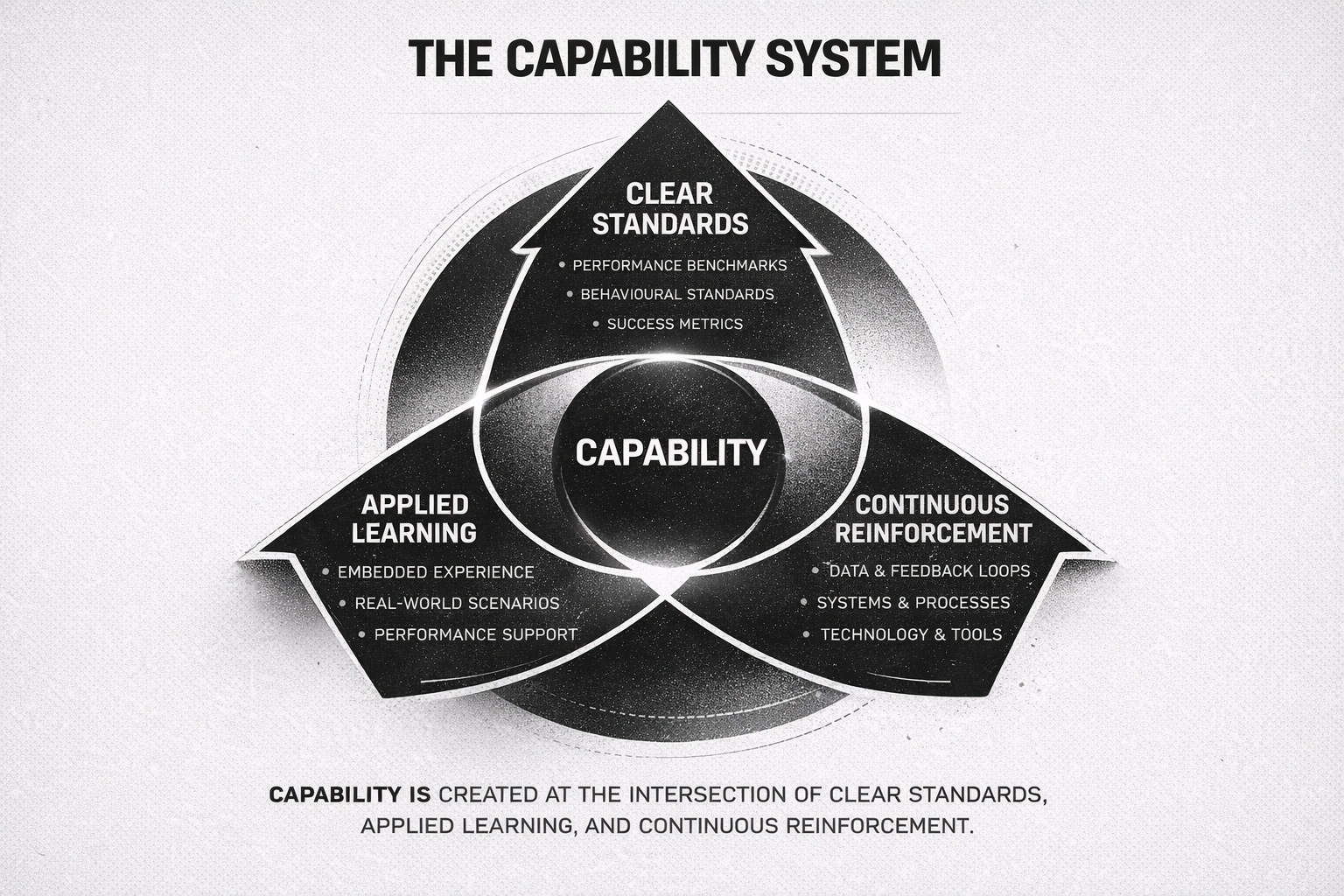
THE THREE CONNECTED LAYERS
-
What does good actually look like?
What behaviours drive performance?
What decisions need to be made?
What standards define success?
This moves beyond knowledge into applied capability.
-
How is capability built in practice?
Learning embedded into real work
Tools and resources that support performance
Experiences that simulate real scenarios
The focus is not on learning about something, but learning through doing.
-
How is capability sustained and improved?
Systems that reinforce behaviours over time
Data to identify performance gaps
Technology (including AI) to personalise and accelerate development
This ensures capability is not a one-time intervention, but an evolving system.
THE CAPABILITY SYSTEM
Capability is created at the intersection of: Clear standards, Applied learning, Continuous reinforcement
When these elements are aligned, learning moves from activity to impact.
COMMERCIAL LINK
Capability design must be grounded in commercial reality. This means understanding:
Where performance is currently lost
What behaviours or skills are driving inefficiency
How improving capability translates into measurable outcomes
Learning becomes valuable when it:
Reduces errors
Improves speed and quality of decisions
Increases consistency across teams
This is where capability design shifts from support function to business driver.